01 / THE INVESTMENT THESIS
Explore commercial models to improve construction productivity
McKinsey’s construction-productivity research places commercial alignment among the levers for better project delivery: involve partners early, make economics transparent and reward shared outcomes rather than isolated contract performance. Its collaborative-contracting work provides the cornerstone for exploring different commercial models-not simply accepting traditional risk transfer as the default.[3][4][5]
Our investment thesis extends that thinking: contractor participation can potentially improve the economics and delivery confidence needed to get a project financed. Shared incentives, delivery commitments and selective equity investment may help close the gap between an owner’s ambition and a financeable project. This is particularly relevant to mining and renewable infrastructure owners seeking both capital and assurance of delivery.
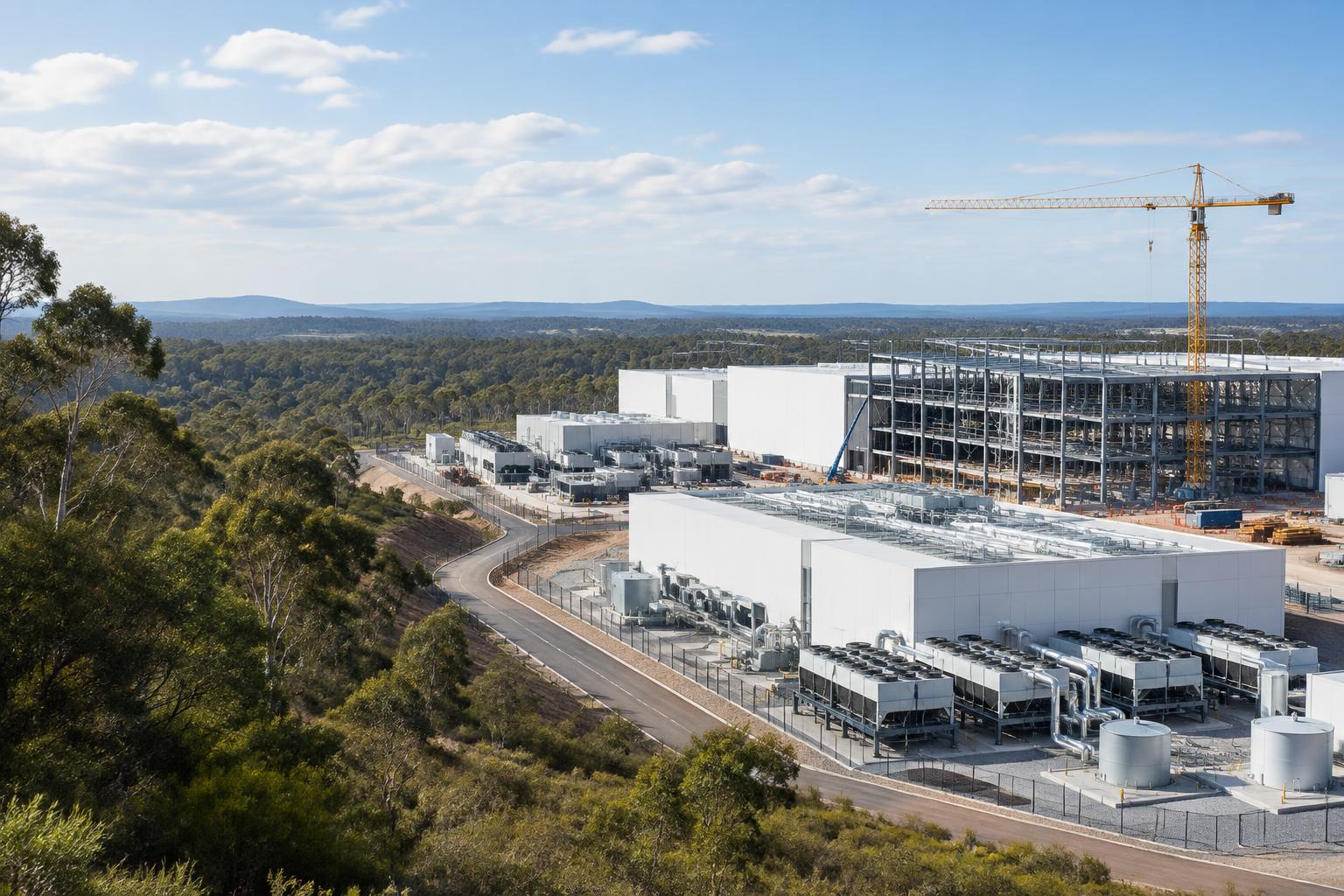
Maas’s investment in Firmus, alongside approximately A$1.1bn of work orders, offers a concrete example of delivery and investment interests coming together. It illustrates a commercial structure worth examining. I don't want to assume this contractor investment model is best fit for every project, or discount the risks.[1][2]
Commercial alignment is not only about sharing the value of a completed asset. It can help make the asset possible in the first place.
02 / THE CENTRAL CASE
Maas & Firmus: Contractor/Supplier, Delivery Partner and Shareholder
Maas Group Holdings includes an electrical-infrastructure delivery arm called JLE. With an awareness of a strong demand for its elecitrcal services, and the financial liquidity provided to it from a recent asset sale, Maas was able to purpose an equity investment in tanden with its supplier contractor role in the Firmus projects.
The strategic attraction is straightforward: Firmus gains a delivery partner with capital committed to its future; Maas combines a substantial order book with participation in the enterprise’s potential upside. This is an interpretation of the alternative commercial terms contractors can pursue. However, time will tell whether or not this investment and commercial alignment will be efficient.
The financial approach should not be to exchange expected margin from the delivery of services for equity. However, a contractor can use the expected margin as a guide for what an investment size could be. The financial stability of the contractor is also critical. This model would not be wise if debt is used to fund the investment, or if a reduced margin contract is pursued.[1][2]
Transaction context and investment risks
It has recently been announcemed that Maas's investment into Firmus has been ~$410M (roughly 2,179,961 shares at $188/share). This is a very substantial investment. It is however balanced against work orders of $1.1B. Projects typically operate (direct on project) margins of 30-40%. Thus, the equity investment is closely aligned to an expected marging from the delivery of services.[1]
In October, Maas reported A$373m of contract payments received and anticipated completion by end CY2027. Firmus had withdrawn its ASX listing application to pursue private-market capital and alternative market options. Therefore, substantial uncertainty exists to both the full delivery of services under existing work orders and risk to the underlying equity value Firmus eventuates with.[2]
03 / THE COMMERCIAL ARCHITECTURE
Equity is one alignment mechanism-not the only one
Start with the owner’s constraint: cost, delivery confidence or access to capital. Shared savings can improve project economics without an equity investment; equity can add capital and a longer-term interest. The appropriate model depends on what the project needs and what the contractor can responsibly support.
Deliver the asset. Exit the economics.
Owner funds the project
Contractor receives delivery fees
Owner retains the residual asset value
The incentive
Payment for scope, plus the agreed delivery margin. A contractor can still be strongly incentivised by reputation, repeat business and performance terms.
The failure mode
The commercial horizon may end at handover, even when a design decision affects decades of operating cost.
What makes it work: Best suited to a well-defined scope, a bankable client and risks the contractor can actually control.
04 / COMPARABLE MODELS
This is not new to infrastructure
Contractor groups have long combined delivery with infrastructure investment. The strongest parallels are business-model precedents-not claims that a road concession has the same risk profile as an AI infrastructure developer.
Project-company co-investment
Skanska / I-4 Ultimate[6]
At financial close in 2014, Skanska disclosed a 50% project-company interest and approximately US$73m in equity and subordinated debt, alongside a separate 40% design-build share. The 40-year concession uses availability payments.
The transferable lesson: An investment stake and a construction contract can be separately financed, priced and governed.
Concession + construction
VINCI / B247 road PPP[7]
VINCI’s 2021 disclosure describes a 30-year German road partnership with construction delivered by group subsidiaries. Remuneration depends on availability rather than traffic volumes.
The transferable lesson: Long-term operating obligations can extend incentives beyond completion; public-sector payment exposure differs from private technology-market demand.
An institutionalised investment platform
ACS / Infrastructure investment[8]
ACS describes infrastructure-investment activities alongside its engineering and construction businesses, including dedicated concession and investment platforms.
The transferable lesson: Co-investment can be a repeatable capability with its own capital discipline, rather than an ad hoc decision to accept shares instead of cash.
These are historical, disclosed structures, not current-holding assertions or evidence of realised investment returns. A project SPV also concentrates exposure in one asset; corporate equity in Firmus introduces a different mix of enterprise, expansion and financing risks.
05 / LOWERING THE FINANCING HURDLE
Some projects need the commercial model to make them possible
A project that cannot be financed without contractor participation is not automatically a weak proposition. Improving delivery economics, sharing risk more credibly and bringing contractor capital into the structure may be precisely what makes it viable. The relevant distinction is between enabling a productive asset and sustaining purchases without a credible path to independent operating cash flow.
For a mining owner, the constraint may be the capital required to develop the asset and confidence in its construction and ramp-up plan. For a renewable infrastructure owner, it may be the combination of upfront capital, completion certainty and contracted revenues. Earlier contractor involvement, shared incentives or selective investment can potentially strengthen the proposition presented to investors and lenders; they do not remove commodity, offtake or operating risk.
The owner’s need creates the pull. Where financing or delivery confidence is a barrier, the owner has a reason to explore a different model and the contractor has an opportunity to offer more than a price. Where a project is already funded and will proceed anyway, that pull may be weak: traditional contracting can remain a rational choice. Commercial alignment is a response to the project’s constraints, not an obligation to adopt equity everywhere.
A productive partnership
- Independent customers value and pay for the asset’s output.
- Delivery pricing remains credible without the equity relationship.
- Capital builds useful capacity, backed by realistic operating economics.
- Contract cash flows and investment returns remain separately visible.
A fragile financial loop
- Demand depends heavily on repeated injections from the supplier.
- Purchase commitments are mistaken for cash receipts or end-user demand.
- Private valuation gains obscure weak operating cash generation.
- The contractor loses its investment just as the customer stops paying.
These are IPEXIQ analytical distinctions, not a finding that Maas–Firmus is circular or that its revenue is artificial. Contractor funding may legitimately enable the project’s construction. The test is whether the combined structure supports credible delivery and sustainable asset economics-not whether the owner could have financed exactly the same project without it.
The objective is to lower the financial hurdle through better project economics and credible delivery support-not merely move the funding gap onto the contractor.
06 / THE INVESTMENT TEST
Six questions before committing contractor capital
The following is an IPEXIQ synthesis, not a prescribed McKinsey checklist. It is designed for boards, owners and delivery partners considering an equity-plus-delivery structure.
- 01
Can we influence the outcome we are underwriting?
Map delivery, operating, demand, power-supply and financing risks separately. Technical expertise does not automatically confer an advantage in forecasting an end market.
- 02
Is the combined financing and delivery proposition credible?
Evaluate the project with the proposed contractor support in place; it need not be financeable without that support. Separately value the equity, document share-class rights and test downside cash flows without relying on valuation uplifts or a timely IPO.
- 03
Is the delivery contract still arm’s length?
Benchmark price, payment terms, guarantees, change control and performance obligations. Identify conflicts, use independent approvals and maintain auditable separation between procurement and investment decisions.
- 04
Can both exposures fail at the same time?
Stress-test slower collections, construction overruns, extra capital calls and a prolonged equity lock-up together. Set concentration limits and protect payroll, subcontractors and ordinary operating liquidity.
- 05
Will whole-of-life value actually change behaviour?
Agree measurable operating outcomes: commissioning reliability, energy efficiency, maintainability, capacity delivered and safe operation. Ownership without information rights or practical influence may not improve decisions.
- 06
Are the alternatives simpler and safer?
Compare equity with target-cost gainshare, early contractor involvement, performance fees and long-term service agreements. Choose the least complex structure that creates the desired alignment.
Let the owner’s needs shape the commercial model
The opportunity is not equity on every project. It is a better route to financing and delivery where the traditional model falls short.
McKinsey’s research gives us a starting point: explore commercial alignment to improve delivery. Maas–Firmus shows how investment and contracting can sit alongside each other. For mining and renewable infrastructure owners who need capital and delivery assurance, that combination deserves consideration. For already-financeable projects, a conventional contract may remain the right answer. The owner’s constraints-and the contractor’s capacity to help resolve them-create the push and pull.
Commercial alignment also needs an execution system behind it: early scope definition, reliable plans, usable information and honest progress measurement. Equity cannot repair a poorly defined project-and a well-designed contract can often align a project without equity at all.
07 / SOURCES & BOUNDARIES
The evidence behind the argument
Evidence cut-off: 16 October 2026. Maas figures are drawn from the dated ASX releases below. Amounts are Australian dollars unless stated otherwise; orders, cash payments, investment cost and valuation gains are not interchangeable.
This is independent IPEXIQ analysis, not McKinsey content or an endorsement by any company mentioned. Sources describe disclosed structures, not proven causation or forecast investment returns. No Firmus job-margin estimate, current private-market valuation or expected investor return is assumed. This article is not investment advice.
- 1.Maas Group - Corporate update
4 August 2026 · ASX announcement
A$855m new order; existing A$200m arrangements; additional A$300m equity purchase; total A$410m / 3.2% interest; fair-value accounting and CEO conflict disclosure.
- 2.Maas Group - Update on Firmus
9 October 2026 · ASX announcement
IPO withdrawal; ordinary and preference share counts; approximately A$1.1bn of work orders; A$373m payments received; anticipated completion by end CY2027.
- 3.McKinsey - Collaborative contracting: Making it happen
2018 · Research & practice
Collaborative practices and incentive structures within traditional contracts, as distinct from full integrated project delivery.
- 4.McKinsey - Collaborative contracting: Moving from pilot to scale-up
2020 · Research & practice
Reported 15–20% cost and schedule improvement in eight collaborative-contract pilots; not evidence of a causal equity-ownership effect.
- 5.McKinsey - An ecosystem of partners: The foundation of capital project excellence
2021 · Capital Projects 5.0
Partnership ecosystems, early collaboration and incentives as part of a wider capital-project transformation.
- 6.Skanska - Financial close on the I-4 Ultimate project
2014 · Company disclosure
50% project-company interest; approximately US$73m equity/subordinated-debt commitment; separate 40% design-build share; 40-year availability-payment concession.
- 7.VINCI - Financing of Germany’s B247 road PPP
2021 · Company disclosure
30-year public-private partnership combining concession and construction; availability-based remuneration rather than traffic-volume exposure.
- 8.ACS - Infrastructure investment
Corporate business-model overview
Institutionalised infrastructure-investment platforms alongside engineering and construction delivery; not a claim that every contract involves co-investment.
- 9.McKinsey - Beating the low-productivity trap
2016 · Construction operations
Contrasts construction economics with higher-margin professional-services businesses; does not establish a universal 30–40% E&C job margin.