Contract Procurement & Development Schedule (CPDS)
A focused tool for managing the development of major execution-phase contracts — from scope handover by Engineering, through bid evaluation and technical clarifications, to award. Built for the contracts that genuinely matter: long-cycle, high-value, heavily-evaluated packages where the path to award is itself a project.
Why contract development is its own project
CII's research on contracting strategy (notably RT-130 and the broader Procurement & Contracts knowledge area) consistently shows that how a major contract is developed — not just what commercial form it takes — is one of the strongest leading indicators of execution outcomes. Rushed awards, ambiguous scope handovers from engineering, and compressed bid evaluations produce disputes long before first concrete is poured.
CPDS treats the path from "engineering has a scope" to "contract is awarded" as a sequence of milestones with real durations, real handovers, and real accountability — not a single line item on the master schedule.
CPDS is built for execution-phase contracting — the major packages that get awarded after FID and drive the construction window. It is not for FEL-stage budget pricing, ROM enquiries, or order-of-magnitude solicitations sent during scope framing.
For early-phase pricing, the right tool is your estimate basis and FEL workflow — see the FEL chapter.
The Engineering → Procurement handover
Every major contract starts the same way: Engineering hands a Scope of Work to Procurement. This is one of the highest-leverage interfaces on a capital project — and one of the most consistently fumbled. CPDS makes it the first explicit milestone of every contract, so the handover is never assumed.
A note on generality. Although CPDS is purpose-built for engineering→procurement handovers, the Interfaces app can also handle document-level handovers between any two parties. The two tools are complementary: CPDS for the contract-development pipeline, Interfaces for the wider deliverable-to-deliverable web.
The CPDS model
A CPDS project is a collection of contracts. Each contract carries a fixed sequence of milestones — from "Commence SoW" through bid issue, bid evaluation, technical and commercial clarifications, recommendation, and final award. Every milestone has a planned date, an actual/forecast date, and a duration that can be tuned per contract.
A common backbone for every package
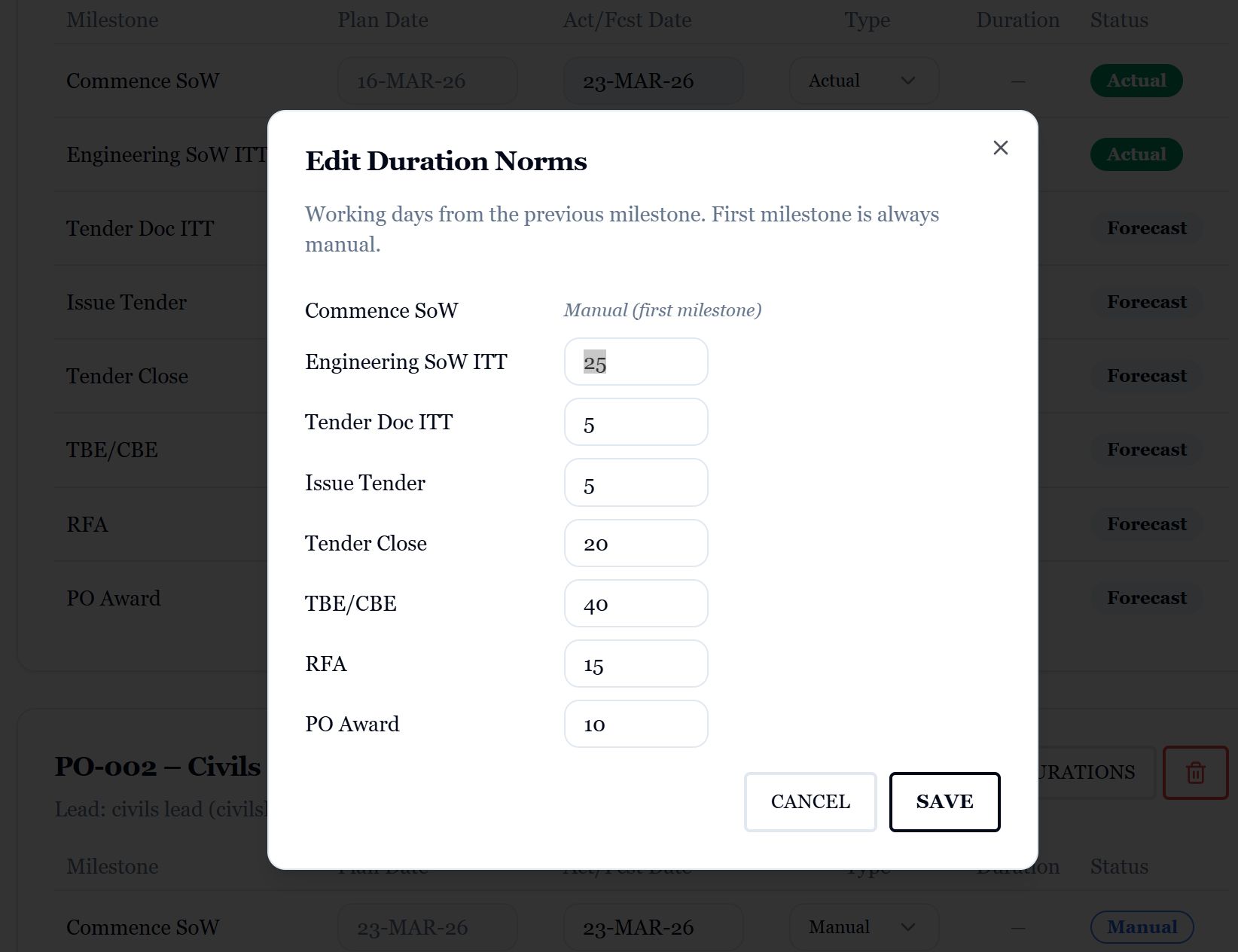
CPDS is built around eight milestones that show up — in some form — on nearly every major contract. Where a package doesn't have one of them explicitly, it can almost always be abstracted onto the closest equivalent. The forecast for award is built by chaining a tunable duration between each milestone.
- 1Commence SoW — Engineering kicks off the Scope of Work — the trigger for the whole pipeline.
- 2Engineering SoW ITT — SoW ready (at least at ITT revision) for inclusion in the tender pack.
- 3Tender Documents ITT — Full tender package assembled. Often runs in parallel with the SoW, but typically completes after it.
- 4Issue Tender — Tender released to bidders.
- 5Tender Close — Bid submission deadline.
- 6TBE / CBE — Technical and Commercial Bid Evaluations — including clarifications.
- 7RFA — Recommendation For Award compiled and submitted for approval.
- 8PO Award — Purchase Order / contract issued. CPDS ends here; expediting takes over.
SoW and Tender docs run in parallel. Engineering SoW and Tender Documents typically progress side-by-side, so both can be entered as manual dates rather than driven purely by duration. The practical constraint is that the SoW must reach at least its ITT revision before the tender pack can close — the SoW is part of the tender.
Where CPDS fits in the project
CPDS is one tool in a contracting strategy — not the whole strategy. CII's procurement research draws a clear line between contract development (getting to award) and contract execution (managing delivery, expediting, and close-out). CPDS is firmly in the first camp.
Scope boundaries
A clear scope makes a tool useful. Here is what CPDS deliberately covers, and what sits outside it.
• Execution-phase major contracts and procurement packages
• Tracking the path from SoW handover to PO/contract award
• Bid evaluation, technical clarification, commercial clarification
• Per-contract tunable durations (so simple POs stay simple)
• Plan vs act/forecast variance per milestone
• Owner-side project view and package-lead update workflows
• FEL-stage budget pricing and ROM enquiries → see FEL
• Cross-party document and data handovers → see Interfaces
• Post-award expediting, vendor data control, materials tracking
• Contract administration, claims, variation management
• Detailed L3/L4 construction scheduling
• Detailed SoW and tender-document review cycles (markups, comment resolution, revision-by-revision tracking)
• The many internal sections of a tender pack — payment schedules, HSE annexes, exhibits, commercial terms — none of which CPDS itemises
• Post-close legal review of the contract before award
• Detailed PO issue approvals and RFA review sub-steps
Major milestones, not micro-steps. CPDS deliberately tracks the milestones that are common across nearly every package — or that can be cleanly abstracted onto the closest equivalent. The hundreds of small tasks behind each milestone (document reviews, legal sign-offs, internal approvals, tender-section preparation) are real work, but they belong in the package lead's own checklist or in a document-control system — not in the contract-development schedule.
CII publications referenced (RT-130, IR165-2, and the Procurement & Contracts knowledge area) are publications of the Construction Industry Institute. References here are for educational alignment; consult source documents for full content.
Ready to schedule your contracts?
Open the CPDS app, set up your first project, and get your major packages on a credible path to award.
Launch the CPDS App